yen carry tra2026-09-21 13:01:04Yen carry unwind risk eases for now, but US asset weakness remains the main triggerThe Bank of Japan raised rates in September as expected, but the move landed below the market’s more aggressive expectations, easing immediate pressure on global markets. According to the report, that softer-than-feared outcome, together with steady US August nonfarm payrolls and lower oil prices, helped limit the spillover. Asia-Pacific equities rose broadly after the decision, while the yen weakened further once the hike was delivered. The piece argues that a disorderly unwind in yen carry trades still requires three pressures to hit at once: higher yen funding costs, a sharp and rapid rise in the yen that creates foreign-exchange losses, and falling prices for US dollar assets such as Treasuries and equities. For now, those conditions have not aligned. The Bank of Japan remains cautious on the pace of tightening, the US-Japan yield gap is still wide at around 200 basis points in the 10-year tenor, and returns on dollar assets have not deteriorated enough to force broad liquidation. Still, the report says the biggest risk sits on the asset side. If the US economy weakens more than expected and that feeds into a sharp equity pullback or a fast drop in Treasury yields, the income cushion behind carry trades could shrink or disappear. That, combined with rising yen funding costs and FX losses, would be the clearest path to concentrated deleveraging.540
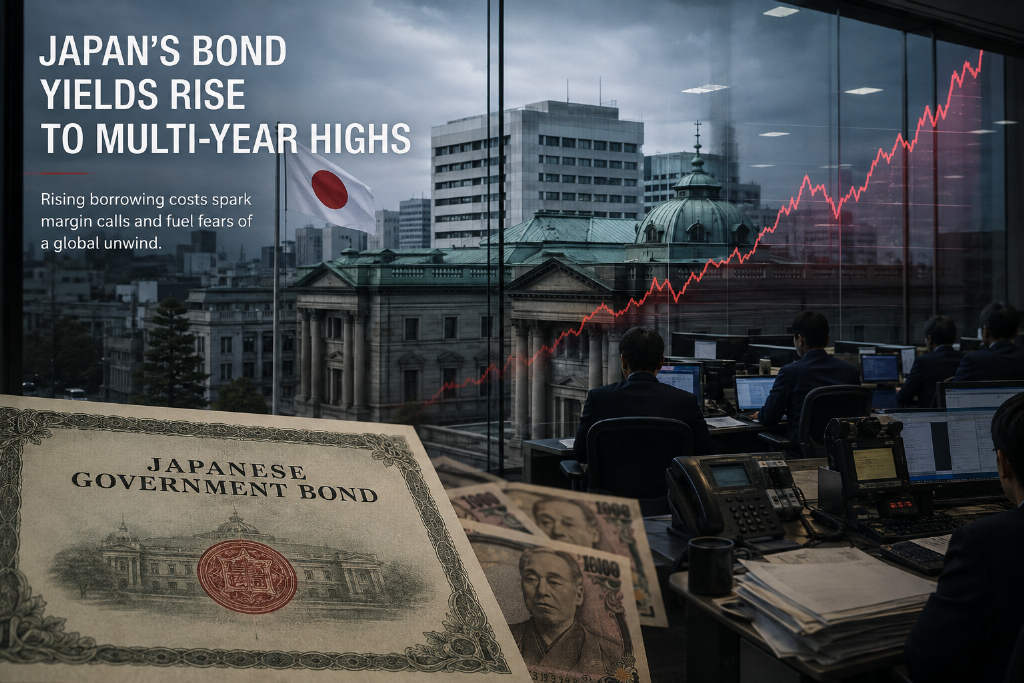
Japan bonds2026-09-03 03:20:07Japan Bond Yields Hit Three-Decade High, Putting Yen Carry Trade Unwind Back in FocusJapan’s 10-year government bond yield has moved above 3% for the first time since September 1996, sharpening market attention on the risk of a broader unwind in yen-funded carry trades. The move comes as the yen remains weak, inflation pressure persists, and expectations for further Bank of Japan tightening build quickly. Markets have fully priced in a 25-basis-point rate hike in September, and some participants have started to consider the possibility of another move in October. The concern reaches far beyond Japan. U.S. Treasury Secretary Bessent has warned that disorderly moves in the yen market could trigger forced liquidations, spread stress across global markets, and eventually raise borrowing costs for U.S. households and businesses. Analysts say carry positions built up since 2024 are meaningful, with investors borrowing cheaply in yen and buying higher-yielding assets and currencies. At the same time, most strategists do not yet see evidence of a large structural reversal, noting that Japanese investors are still buying overseas assets and have not clearly shifted funds back home. Because Japan is the largest foreign holder of U.S. Treasuries, any reallocation by its pension funds and life insurers is being watched closely as domestic yields rise.1310
Policy Regula2026-09-01 11:33:02CoinDesk says Bessent reportedly urged Japan to raise rates as bitcoin still faces yen carry-trade riskAccording to CoinDesk, U.S. Treasury Secretary Bessent recently reportedly urged Japan to raise interest rates to curb the yen’s continued decline. The report uses that episode to highlight a contrast between traditional monetary systems and Bitcoin: fiat policy can be shaped by governments and outside pressure, while Bitcoin’s issuance schedule is set in code, follows a fixed rhythm, and halves roughly every four years. That makes Bitcoin’s monetary policy more predictable on paper. Still, the report notes that Bitcoin has not broken free from the pull of traditional markets in the short term. If Japanese rate hikes were to trigger a sharp rebound in the yen, long-built low-rate yen-funded carry trades could unwind, leading to selling across stocks, bonds, and crypto assets. CoinDesk also points to a prior example in August 2024, when a Bank of Japan rate hike strengthened the yen and weighed on risk assets, including Bitcoin. On the technical side, BTC’s 50-day moving average is still rising and nearing a move above the 200-day moving average, which could produce a so-called golden cross. Even so, the report says moving averages are lagging indicators, and the golden cross has shown uneven historical forecasting value when used on its own.750
Bank of Japan2026-08-26 10:03:21Japan Yields Return to 1996 Levels as Bitcoin Faces Carry Trade Risk Ahead of September BOJ MeetingJapan’s borrowing costs have climbed to their highest levels since 1996, with the 30-year government bond yield reaching 4.185% and the 10-year yield at 2.945%, reviving scrutiny of how a shift in Japanese rates could ripple through global risk assets. The article argues that the yen carry trade remains a major transmission channel: investors have long borrowed cheap yen, converted it into dollars, and deployed the funds into higher-yielding assets, including positions linked to crypto markets. At the same time, Bitcoin has risen 22% over the past week and moved back above $80,000 for the first time since May, creating tension between a volatile Japanese bond market and a relatively resilient crypto market. The report lays out two paths. If the Bank of Japan tightens more aggressively and the yen strengthens, carry trades could unwind and trigger broader deleveraging, much like the move in August 2024 when Bitcoin fell from about $64,600 to $49,000 and TOPIX dropped 12% in a day. If the yen weakens instead, Bitcoin could draw support from domestic Japanese buyers and continued institutional participation. The next Bank of Japan meeting on Sept. 17-18 is presented as the key policy window.970
Japan2026-08-25 09:23:36Japan’s FY2027 debt-service request rises to 36.64 trillion yen as assumed rate climbs to 3.8%Japan’s Ministry of Finance has compiled its initial budget request for fiscal 2027, setting debt-servicing costs at 36.6386 trillion yen, or about $229.94 billion, for principal repayments and interest payments on government bonds. The figure is 17.1% higher than the initial budget for the current fiscal year, marking a record high in both size and annual increase, with the gain of roughly 5.3 trillion yen described in the source material as the largest in nearly two decades. A key driver is the ministry’s assumed interest rate used to estimate future debt interest expenses. That rate was lifted from 3.0% for fiscal 2026 to 3.8% for fiscal 2027. According to Jiji Press, the ministry arrived at the 3.8% figure by adding about 1.1 percentage points on top of prevailing market levels as a buffer against a sharp rise in rates. The move comes as Japanese government bond yields remain elevated and markets price in a high probability of another Bank of Japan rate hike at its Sept. 17-18 policy meeting. The source material also notes that changes in Japan’s rate outlook are being watched for their possible effects on yen carry trades and liquidity across risk assets, including crypto.1000
HashKey2026-08-19 10:02:00HashKey says FIMA may cushion the yen carry unwind, with Bitcoin and gold in focusHashKey Group chief analyst Jeffrey Ding argues that the global market is approaching a structural break as the Bank of Japan raises rates and the Federal Reserve cuts them, narrowing the U.S.-Japan rate gap and eroding the foundation of the yen carry trade. In his view, a decades-long model built on borrowing cheap yen to buy higher-yielding dollar assets is now under pressure from three directions at once: Japan’s exit from negative rates, shrinking yield differentials, and a weaker one-way case for yen depreciation. The article centers on the Federal Reserve’s Foreign and International Monetary Authorities repo facility, or FIMA, which allows foreign central banks to pledge U.S. Treasuries and obtain dollars without selling bonds into the open market. Ding says that mechanism could help Japan support the yen while avoiding a disorderly Treasury sell-off, but it comes with a cost: newly created dollars would flow back into the global financial system, adding liquidity. HashKey’s conclusion is that if FIMA becomes the preferred path, Bitcoin and gold could be among the main beneficiaries of the next phase, while U.S. technology stocks, Treasuries and other risk assets may still face deleveraging pressure as carry positions unwind.1570
Bitunix2026-08-14 06:49:34Bitunix says softer PPI eases rate hike bets, but long-dated Treasury supply and yen carry trades still cap the outlook for ratesBitunix said July producer price data in the United States eased some of the pressure around another Federal Reserve rate increase, but did not resolve the broader issue of high long-term funding costs. U.S. July PPI was flat on a monthly basis and rose 4.7% from a year earlier, while cooling CPI data released a day earlier also pointed to easing price pressure as energy costs retreated. Following the data, market pricing for a September Fed hike fell from about 50% to roughly 35% to 40%. The firm also highlighted signs that inflation pressure has not fully disappeared. Core final demand PPI, excluding food, energy and trade services, rose 0.4% month over month. Initial jobless claims increased to 209,000, suggesting some cooling in the labor market. Bitunix argued that the bigger constraint lies in long-term financing conditions. A $25 billion sale of 30-year U.S. Treasurys cleared at a high yield of 5.216%, the highest auction yield since 2001. With fiscal deficits elevated, Treasury supply increasing and the Federal Reserve no longer acting as the main buyer, longer-dated bonds may need a higher term premium to absorb supply. The firm added that yen carry trades remain another source of risk after USD/JPY moved back toward 160 following Japan’s intervention in the currency market.1450
Yen carry tra2026-08-03 19:36:10US-Japan yen intervention reshapes carry trade risk, but rate gap still drives the bigger trendJapanese officials said Tokyo coordinated with the US Treasury to buy yen, and both President Donald Trump and Treasury Secretary Scott Bessent later confirmed US participation while leaving the door open to another joint operation. After those statements, USD/JPY pulled back sharply from levels near 164 seen last week, at one point falling to around 155.20, while an Associated Press reading on the morning of Aug. 3 showed the pair near 156.34. A Reuters photograph taken on July 31 added another layer to the story. Bessent’s notepad at a Camp David cabinet meeting included the line: "To Do: Buy Japanese Yen (JPY) $5-10 bil." That note does not confirm how much was actually bought, and the US Treasury had not formally verified a figure at the time. Even so, the image suggested Washington had considered a purchase large enough to matter to leveraged traders. The intervention has changed the risk profile of yen-funded carry trades rather than erased the strategy outright. The Federal Reserve kept its federal funds target range at 3.50% to 3.75% on July 29, while the Bank of Japan left its short-term policy rate at 1% on July 31. Japan’s financing choices also matter for global markets: Bessent said the Federal Reserve’s FIMA repo facility was used in the operation, a mechanism that can provide dollar liquidity against Treasuries without requiring immediate outright sales.1900